
Being Held Between
In conversation with Body Suspension artist Amy Kingsmill
Amy Kingsmill and Imke F. Gerhardt | May 2026
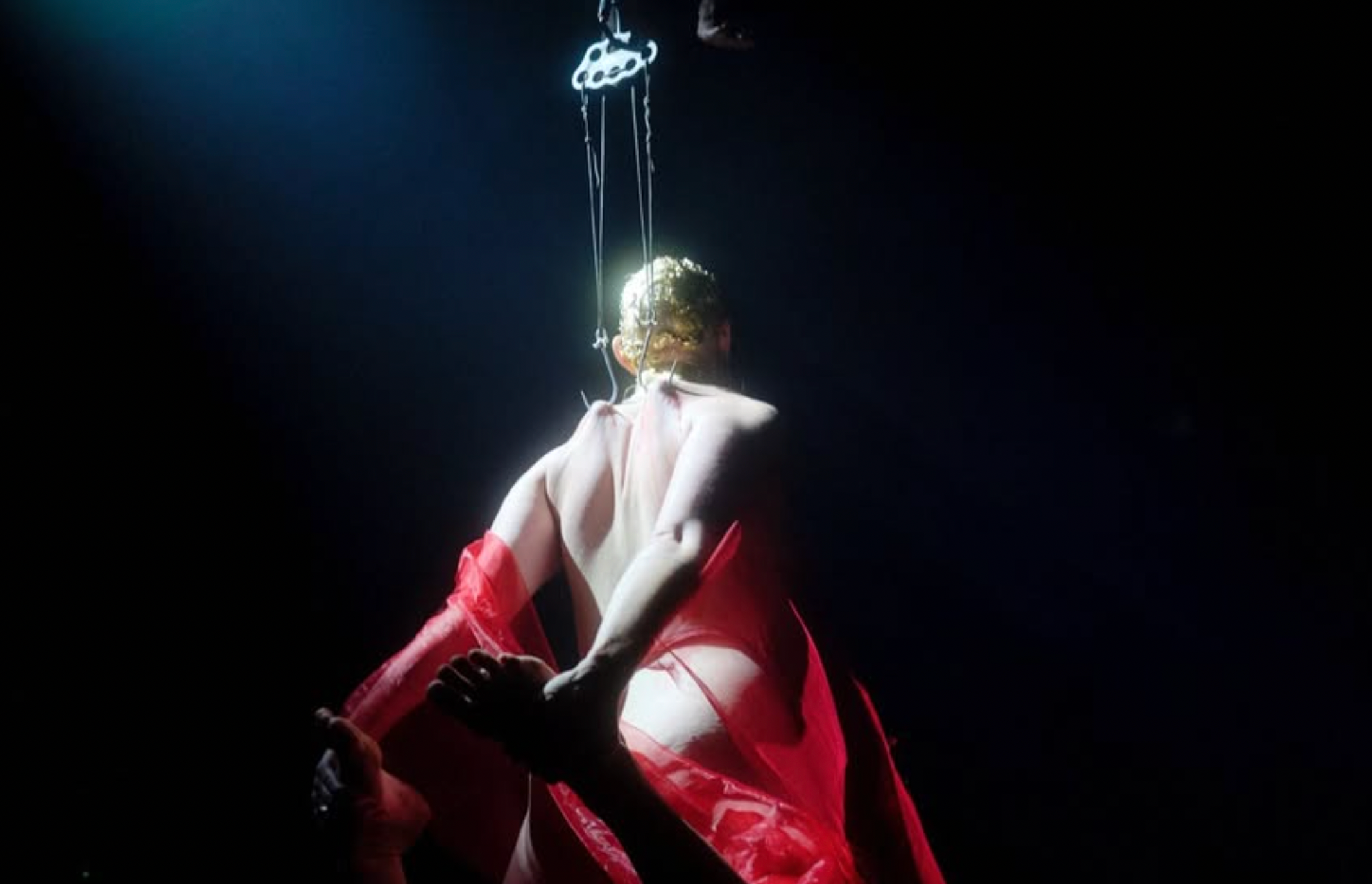
Carried by the poetic weight of the word suspension, this dialogue with performance artist Amy Kingsmill circles around dualities, searching for what lies in between. Amy Kingsmill describes the liminal states during suspension between pain and pleasure, presence and transcendence, weight and lightness. Central here is the body’s experience – and how we inhabit it. The artist reflects on how moments of being othered drew her to this practice, a practice that allowed her to reclaim autonomy over her body.
As much as body suspension invites philosophical reflection, this conversation never drifts solely in metaphor. It becomes strikingly concrete in time: How many hooks does it take to float? How many people, to be lifted? And what is the best setting? From finding support in the kink scene to starring as the mother in Bruce LaBruce’s new film The Visitor, Amy Kingsmill shares what it takes to be lifted above the ordinary.
Imke: Body modification practices seem not only to affect the bodily constitution of the practitioner but also to trigger a visceral, bodily response in the spectator. To some, this is deeply fascinating; to others, appalling – Julia Kristeva’s Powers of Horror comes to mind.
What has drawn you to this practice?
Amy: The first time I tried it was in art school, although I had learned about it beforehand. There was a magazine called Bizarre, which explored fetish, and queer subcultures, as well as underground cinema and other fringe practices. It frequently featured articles on body modification and practices such as hook suspension. It also seems relevant to mention that my father was a hypnotherapist.
Imke: Which, I assume, implies that you grew up in an environment attuned to – and perhaps even engaged in – practices involving altered states of consciousness. My own interest in body modification stem from a similar fascination with altered mental states, particularly those of heightened or focused attention that, in turn, transform one’s perception of being in time and space.
Amy: Yes, and in this environment I also learned about the body’s capacity to heal itself – and, broadly about the power of the mind over the body. My mother was a biology teacher who kept anatomical models in her car. All of this certainly shaped my fascination with the body and with the strange or uncanny more generally.
This fascination deepened as I grew older. During a difficult adolescence – marked by bullying and my father’s illness, Huntington’s Disease – I found both interest and solace in exploring spiritual practices. Pagan witchcraft and ritual spirituality gradually became part of my life and personal inquiry.
I remember one Christmas as a child when I received a spell a day diary – something like an almanac – from my godmother. She was queer, which was also very significant for me, as it provided another influential example that there is more beyond the straight status quo.
Later, as I mentioned, when I was about fifteen, I came across Bizarre magazine. I saw images of body modification, and I immediately knew that I wanted to pursue it.
Imke: This immediate, bodily fascination with it is what I referred to at the beginning. I mentioned Julia Kristen’s Powers of Horror, in which she elaborates on the concept of the abject, defining it as the intrusion of the Real into the Symbolic Order. The abject represents taboo elements of the self that the subject seeks to separate, because they disturb one’s sense of identity and the system of order in general. The abject often consists of something that was once part of the subject but, through transformation, has crossed a boundary, provoking repulsion because it challenged the integrity of the self. Wounds, for example can cause abjection, because the skin, as a protective barrier outlining our being, is violated. The abject can provoke revulsion; yet – thinking of the anatomical theatre – it has also always elicited fascination. People are drawn to such transgressions of boundaries, driven by a desire to explore what lies beneath the surface.
Amy: For Ron Athey – a Colleague and friend of mine – the abject can play a central role in his work. Engaging with the abject and confronting the obliteration of the self can serve as a powerful artistic and therapeutic tool. As I mentioned earlier, I experienced significant bullying during adolescence and faced the challenge of my father being ill with Huntington’s disease – circumstances in which I felt deeply disempowered. Yet these experiences also heightened my awareness of the body’s resilience and its latent potential for agency.
Due to those circumstances, I had to experience a profound lack of bodily autonomy. My engagement with pain-based practices and related explorations was, in part, a means of reclaiming agency over my own body. Body-centred work, in this sense, allows for profound forms of reclamation: trauma and repressed material stored in the unconscious can often be accessed and transformed through somatic experience in ways that language alone cannot facilitate.
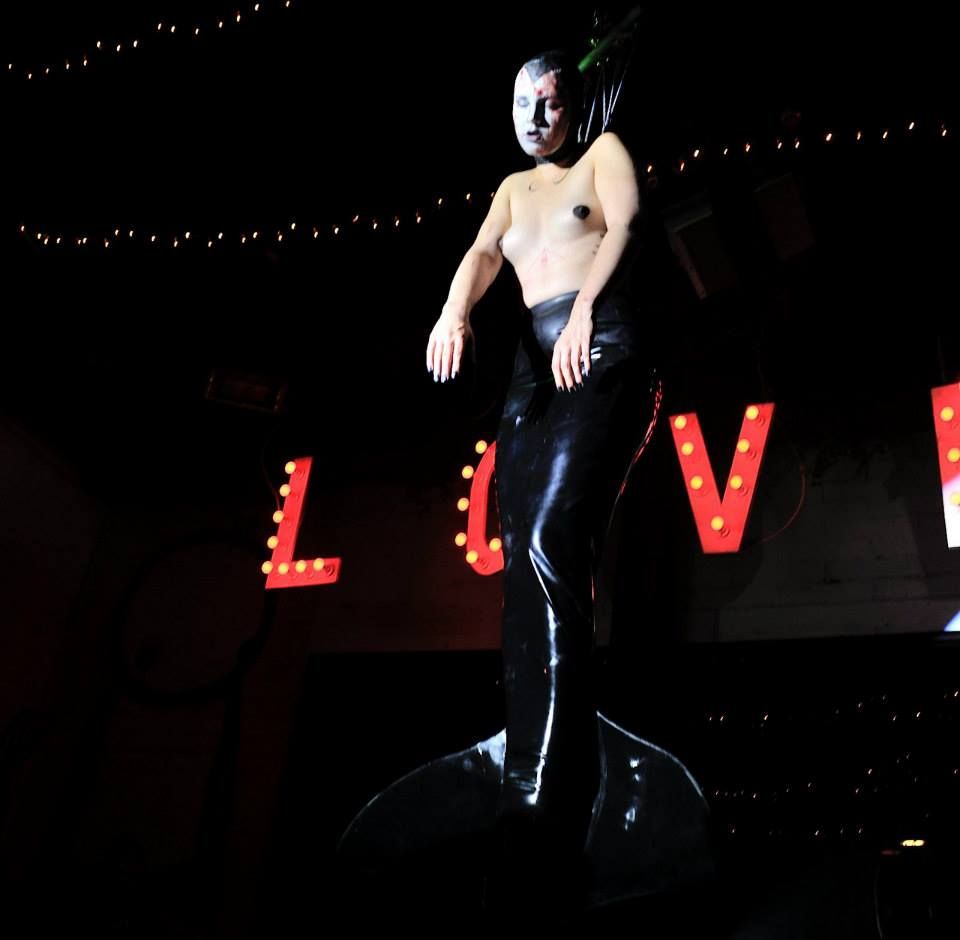
Imke: Perhaps this is because somatic practices are often highly processual and observational, requiring a sensitive, introspective engagement with oneself. Some body modification artists describe suspension as a rite of passage. This is not a rite of passage in the sense commonly defined by cultural anthropology, but rather as an individual, internal transition – for example, the overcoming of one’s fears or limitations.
Amy: Indeed, it is fundamentally about reclaiming one’s relationship with the body. This process is deeply entwined with trust – the ability to say: I trust my body, I trust myself, I trust this practitioner. Such acts of trust, whether in oneself or in another, are profoundly powerful and transformative.
Imke: With regard to trusting others, does body suspension necessarily require the involvement of professionals?
Amy: Yes, it does. However, the number of people involved depends on whether it is a public performance or a private, personal suspension – which is how I began. I wanted my first experience to be an intimate one, outdoors, and I wanted to work with a piercer who was both a woman and a friend.
But I also want to say one more thing in regard to trust. If I encounter in my everyday life, a rude or aggressive individual – perhaps middle aged men – I am able to face the situation because I feel strong and grounded. Having been a carer and having buried someone a similar age when I was twenty-one, I gained a deep, embodied understanding of vulnerability and resilience. Caretaking, as a physically engaged practice, taught me invaluable lessons and heightened my awareness of both myself and others.
This embodied knowledge enables me to create a space as a queer performer in which I can feel genuinely empowered. The moment of suspension – of being lifted off the ground – is a magical experience, serving not only as a powerful symbol but also as a literal elevation above past trauma.
Imke: That makes sense to me, as floating allows one to experience weightlessness and evokes a sense of freedom or release. In the context of suspension, I envision it as an almost dreamlike or transcendent state. However, to reach this state – which is likely very detached from ordinary bodily or spatial sensations – one must first be pierced. I’m curious to hear how differently these two moments feel from a mind-body perspective but also how they are connected.
I would assume that the act of piercing – particularly when contrasted with the weightlessness of the lift – might feel like a deep, intense penetration of the body, sharply heightening bodily awareness. In contrast, I imagine the moment of lifting as a transcendence beyond that pain, an almost liberating sensation. Of course, I may be mistaken, and I am certain that the experience varies depending on the placement of the hooks and the position in which one is suspended.
Amy: Piercing and the act of lifting are connected by more than just the practical need for a hole to insert the hook. The act of piercing has an important psychological function: it prepares you both mentally and physically. Piercing triggers the body’s release of adrenaline, which helps you endure the actual lifting.
This connection can be seen in various Indigenous and Native American traditions. Many of their ceremonies – such as the Okeepa ceremony – include pain and piercing rituals as a form of preparation. The adrenaline released during these practices acts as a natural painkiller.
The process typically unfolds as follows: first, the piercing is done, and then you usually go straight to the place where you’ll suspend. Next, carabiners or hooks are clipped in, and a rigger assists in lifting you. The method can vary depending on whether an electric winch is used, or, in more complex positions, the rigger may remove the support beneath your feet instead.
The actual lifting is quite a magical moment for me. Of course, it’s difficult – it’s scary, and it feels like that moment right before jumping off a cliff – but you’re able to push through it because of the adrenaline released during the piercing. You’ll experience pain and discomfort as you are lifted, but usually only to a bearable degree. The intensity also depends on the placement of the hooks. Personally, I prefer a two-point upper back suspension because it feels the most comfortable for me. This setup allows me to remain hanging in that position for 20 minutes or even longer.
If it is a more challenging position you would usually have a conversation with the people you are working with and you let them know how long you are realistically able to be in the air.
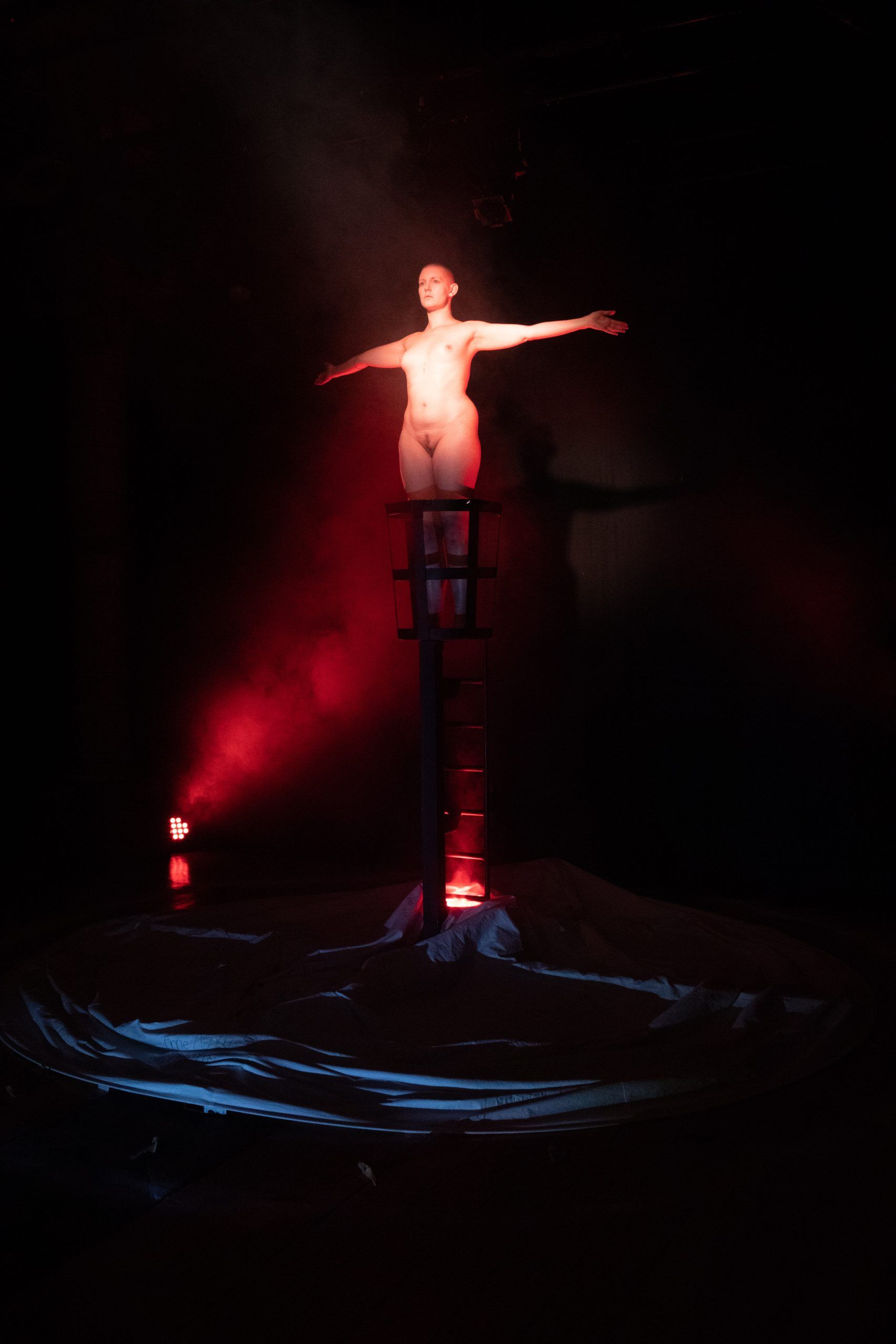
For example, the position Bruce LaBruce chose for his film The Visitor, in which I starred as the mother, was a difficult one. It was a hybrid between two poses – the resurrection and the crucifix position. I had hooks placed in my chest, arms, and legs, and the pose involved a chest lift, which puts considerable pressure on that part of the body. I knew it would be a challenging position, and I had never tried it before the shoot.
Nevertheless, it was manageable because I was working with excellent facilitators – a skilled rigger and piercer I had collaborated with before. It also went so smoothly thanks to the communication between us and Bruce. Not only did I trust him with the project; he also trusted us. He allowed us to take the lead and to explain how and under what conditions the suspension could be done.
It was a very professional collaboration based on mutual respect for each other’s artistry. Working with Bruce was a pleasure – he was genuinely excited to have suspension artists on board and curious about our practice. It was meaningful to be part of a project by someone so significant to queer cinema, and who is known for capturing the unorthodox in such an artistic way.
Imke: I can imagine that this collaboration was particularly stimulating on a creative level. Considering, however, that suspension is such a high-risk and intense practice – and that few people have personal experience with it – I had assumed that you would always maintain full control over how and under what conditions it is carried out. Have you ever encountered any negative or challenging experiences in the past?
Amy: Yes, unfortunately, things do go wrong at times, usually due to a lack of professionalism and care. When that happens, I try to find new collaborators. However, when it comes to venues and event, this can be more difficult, as my career depends on maintaining those relationships. The issues can range from disagreements with management and a lack of understanding or respect for my practice, to more serious concerns regarding health and safety – such as being being put in non-sterile environments for piercing.
Because of these experiences, I created a support space for performance artists engaged in extreme practices. It provides a forum to discuss safer ways of performing body suspension + other performance practices and allows us to speak collectively – in a sense, as a union advocating for our rights. It is not only unprofessional but also unacceptable that artists are ever placed at risk.
Imke: Yes, this feels absolutely intolerable and, in many ways, quite sad – particularly in light of your earlier point that the beauty of this practice lies in cultivating trust, both in oneself and in others, as you quite literally place your life in their hands. Even before you said that, I found myself wondering: do you view body suspension as an individual practice, or as something fundamentally shared?
Amy: For me, It’s a shared ritual – like the saying, it takes a village to raise a child. Unlike other embodied practices that can unfold spontaneously in informal or organic settings, body suspension requires specialised knowledge, extensive preparation, and the involvement of trained practitioners. As such, it cannot simply emerge from casual social encounters. Rather, it is like a folk practice, in which knowledge is transmitted directly from body to body through lived, physical experience rather than through purely textual or abstract instruction.
Imke: Yes, I have been thinking about how demanding the initiation process is and how the experience likely changes between private and public contexts. You mentioned wanting your first suspension to take place in nature, privately, among trusted individuals. I am curious how such a setting, as opposed to a public performance, shapes your bodily experience. Given the practice’s origin in Indigenous cultures and your interest in pagan rituals, choosing a natural environment for your first suspension seems coherent. At the same time, I wonder whether performing before an audience – through the added adrenaline of being watched – might alter your body perception and potentially increase pain tolerance?
Amy: I’m increasingly fortunate to be selective about the bookings I accept. Even in public settings, I generally feel safe within the scenes I choose to participate in, which enables me to engage more fully in the experience. Nevertheless, it remains important for me to undertake personal suspensions from time to time. In those private contexts, I can concentrate entirely on the embodied experience without being distracted by logistical concerns such as timing, lighting, or music cues.
However, “private” does not imply being on my own. As said before, the practice inherently requires the involvement of others, and in ritual contexts I find it valuable to be guided through the process. Having someone else hold the structure allows my body to remain fully present, rather than preoccupied with preparation or procedure.
At the same time, like many performers, I also appreciate the presence of an audience, as it can heighten adrenaline and intensify the experience. Yet this dynamic can also increase stress in the days leading up to a performance – particularly when I have chosen a technically or physically demanding suspension.
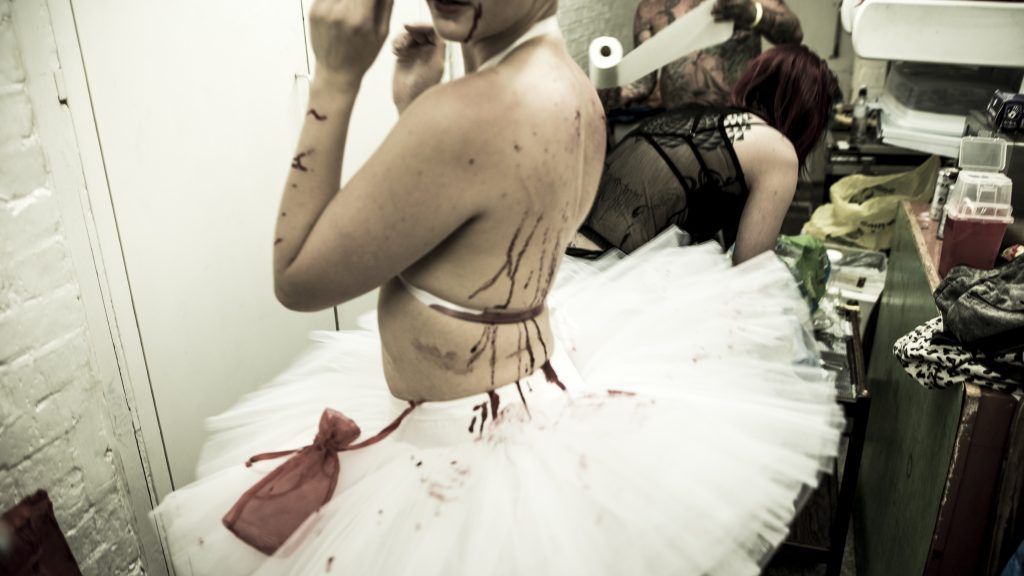
Imke: Regarding the days leading up to a suspension, I am curious whether you engage in any preparatory rituals before entering such an intense practice. I was thinking of artists like Marina Abramović, who is known for ritualised methods of preparation – such as periods of isolation, abstaining from communication, or bathing in cold water to attune the body and mind before a performance.
Amy: It largely depends on how much time and space are available, as well as on individual preference. When I am able, I value having a period of rest beforehand, though this often feels like a luxury. The specific preparation also varies according to the nature of the piece. For long-durational performances, for instance, I focus on nutrition and make sure to consume slow-releasing proteins. You can also avoid taking blood-thinning painkillers to prevent excessive bleeding – unless, of course, that effect is intentionally part of the performance.
Imke: That means that body suspension, which is often perceived by observers as an extremely painful or even self-destructive act, actually involves a significant degree of bodily care. From the outside, the practice may appear solely defined by pain, yet pain in this context is highly relative. I would assume that, for you, the experience of pain is intertwined with other sensation, including perhaps a form of pleasure or release. Would you say that pain, rather than being purely negative, becomes productive or even desirable within this practice?
Amy: In my adolescence, I engaged in self-harm and was unwell, but the pain associated with my current practice is fundamentally different. It does not stem from a self-destructive impulse, nor is it driven by the same desire. I am now in control of that impulse, and there is no causal link between emotional distress and the decision to suspend. The motivation is not to escape or punish the body, but to engage with it intentionally.
This journey has also been one of learning to know my body, a development that has largely taken place within the context of the queer kink scene. I want to emphasise that this has not been a linear process, and I have encountered challenges along the way. My practice is closely linked to this scene, which has generally provided a space for experimentation, though not all experiences or relationships were healthy. Importantly, the kink scene allowed me to engage in physical play that was not necessarily sexual. It offered the freedom to explore what I wanted in a context centred on sexuality without requiring sexual participation. This practice has been about discovering what brings me pleasure, developing a bodily practice that I can embrace fully, and, in doing so, queering the very notion of pleasure itself.