
Crusssh
Moving Discourse in conversation with juliette yasmine mello
juliette yasmine mello & Imke F. Gerhardt | May 2026
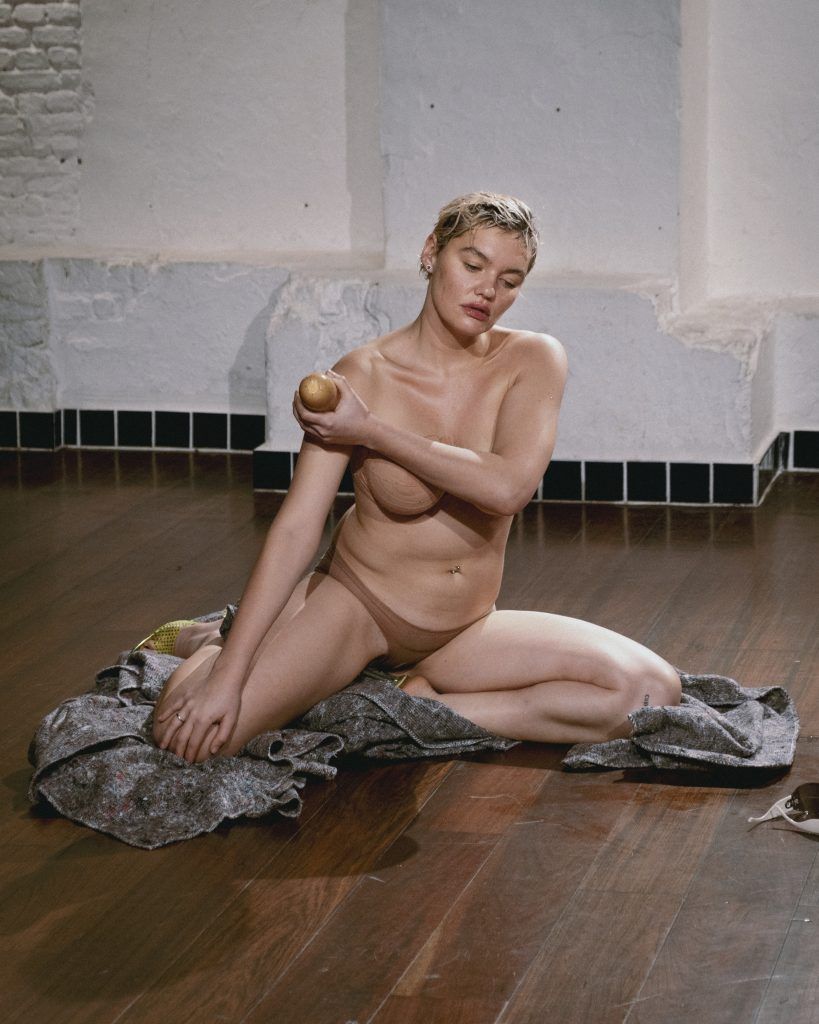
As part of Chapter 2, Vision and Flesh, Moving Discourse is in conversation with performance artist juliette yasmine mello about their work Crusssh, in which the artist assembles a patchwork presence that playfully extends and destabilises the notion of a coherent self. The conversation interrogates the conditions under which the performance and construction of subjectivity might operate as a subversive and creative practice, given that self-fashioning is already structurally embedded within the imperatives of digital late capitalism. What relation emerges between self-image and imagination within a visual regime saturated by images that are continuously internalised?
Attending to the body, we consider how such images are incorporated, embodied, and reiterated through performative repetition. The discussion further turns to seduction, examining both the ways in which subjects are captured by images and how seduction itself is enacted as a performative strategy.
Imke: In Crusssh, you construct a patchwork identity composed of multiple presences. This seems to reflect a broader condition of digital late capitalism, in which subjects are increasingly compelled to produce and curate themselves – particularly through platforms such as Instagram. While this suggests an expanded agency, it is simultaneously shaped by systems that standardise and commodify identity, often resulting in surprisingly homogeneous forms of self-presentation.
At the same time, digital environments open up possibilities for self-authoring that resemble forms of autofiction: the capacity to fictionalise, extend, and multiply the self; to layer identities; to incorporate speculative or imaginative elements into one’s own presentation. You’ve described your practice as both constructing and undoing such narratives. Could you speak about how this patchwork identity in Crusssh emerged, and how you developed these multiple presences?
juliette: I think a lot of it stems from intuition. Some kind of occult space, or ghost space – that moves between what I can’t fully explain and what I might try to articulate through more theoretical or rational thinking. It’s this circulation between the two that eventually produces the patchwork.
Working with this patchwork is also a way of not choosing – stepping away from a central core or a single narrative backbone. Instead, it’s more like a collage: different elements that speak to one another horizontally rather than being organised around a centre.
Of course, this is shaped by the conditions we live in. I’m thinking about technology, about how the body relates to it, and about the image-saturated culture we inhabit. I’m interested in how I can move between a critical, political, or collective way of engaging with these questions, and this more intimate and emotional form of knowledge. That circulation fuels my inner dialogue: how do I feel politically about this image-driven culture and the pressures it produces, and how does that translate into my lived, embodied experience? Because even when you develop a critique, emotionally you don’t always align with it. You might want to resist these systems, but you still feel their effects – through self-judgement, discomfort, or the desire to be seen. That tension is what interests me, finding the honesty to acknowledge that I long to free myself from the pressure of images, but that I’m also deeply attached to them. That I still want to be perceived as beautiful, and simultaneously as detached from that need, beyond these superficial containers. It’s a complex relationship. Like crochet in a way, it’s an accumulation of knots that form a pattern. Something that holds its own coherence, but that you can’t really untangle. Some parts of the patchwork come from shortcomings, others from fantasies, and others from trying to embody something I might not even want to be.
Imke: You mentioned discomfort in relation to the body, and I’m thinking about how this connects to relationality and the construction of images. Even if social media offers space to experiment with fantasy and self-fashioning, these constructions are always oriented toward the other – toward being seen, validated, and valued. The structure of platforms like Instagram reinforces this through quantification and feedback. I’m interested here in seduction. When I try to seduce someone, I realise I’m not just acting spontaneously – it’s rather as if I’m performing a role and projecting an image of myself into the space. It’s not quite dissociation, but rather taking on a role, projecting an image that the other immediately responds to. That response can feel empowering, but also deeply vulnerable, since it carries the possibility of rejection.
When you speak about constructing and playing with different images of yourself, I sense that seduction becomes part of that process. You once described seduction as a form of negotiation within a charged field, which I find very compelling. Could you speak about how this negotiation unfolds in Crush, particularly in relation to the audience. And since the work involves improvisation and relational exchange, I’m also wondering how you prepare for it. Do you anticipate possible reactions, or is that deliberately left open? How do you approach preparation for something that is meant to unfold in the moment?
juliette: I think the process of making Crusssh has been about trying to build it towards something more structured, that can be repeated or reproduced. In that sense, it’s different from The Fountain of Youth [another work of Juliette], which was much more open-ended, more like a happening. With Crusssh, I’m working with ideas and with a set of materials that amplify these questions – especially about how to embody a seductive being: how to metabolise it, how to break it down, and where to locate it within oneself. In this process, I’m working with a lot of confusion and disconnection, like both trying and failing to make sense of this seductive body.
I’m also thinking about the kinds of artefacts we associate with seduction – particularly in relation to the hyper-feminine or femme body – and what it means to embody those attributes. It’s a tense space to express a desire of becoming this seductive presence, to claim a kind of magnetic, erotic power, and to feel liberated from the self-censoring forces that make us feel small, afraid, or disembodied. Within that, I find myself wrestling with questions around the performance of confidence, seduction, and sexuality – how we perceive it, how we judge it, how we assign value to it. And then there’s also this parallel desire to desexualise everything – to think beyond the sexual, and to separate the apparatus from the intention. It’s blurry, sometimes you do something in order to seduce, and sometimes you do the same thing without wanting to seduce at all. In a way, this whole process can feel therapeutic, but it’s really about staying with these questions, so it’s super sticky.
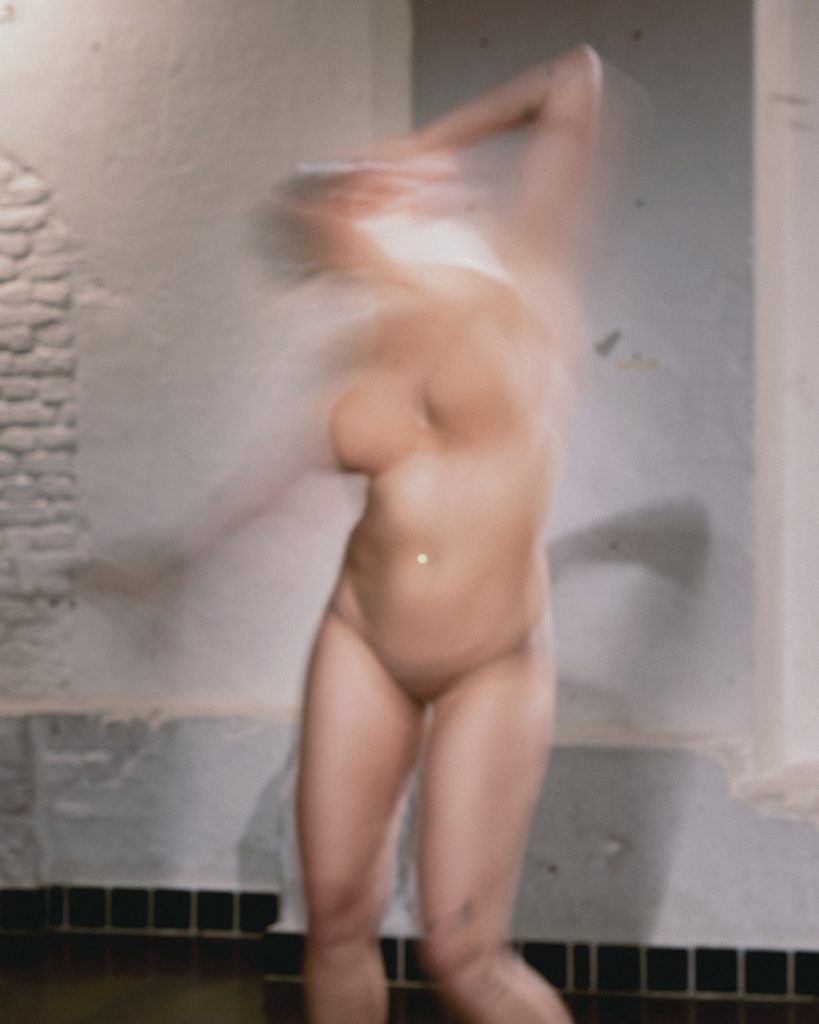
Imke: Is that split into different presences, or is it something that can shift? Can it change in the moment, even within the performance?
juliette: What I’m busy with thinking about is more related to the space of life outside the work. Translating that into a performance means working with different tools. One of them is making a song, but also choreographic thinking – motifs I return to, like loops, repetition, distortion. I’m interested in shifting perception, also sonically.
For example, borrowing from chopped and screwed technique (Houston born, hip hop genre pioneered by Dj Screw)” slowing down, distorting, layering songs – I sing my own slurred song from samples that influenced me. The change of pace allows you to hear the separation between each element. It can make you feel slightly woozy, like being in an altered state where everything is delayed or a bit dissociated. That sonic experience really affects me internally. For me, this speaks to the complexity of being: feeling disembodied, objectified, uncomfortable, but also experiencing pleasure at the same time. I also think about language – the symbolic landscape of words. Even the term “chopped and screwed” points to manipulation: things being twisted, cut up. I feel like my body has been “chopped and screwed.” We live in a time where we are constantly manipulated, fragmenting and distorting our experiences. Our flesh goes through that process as well. The song is a tool to expand this conflict, things I am wrestling with, like what it means to be perceived as femme – to inhabit a body that can be read as hyper-feminine – and how others project onto it. What kind of feedback is directed toward you? What kind of force is being enacted? How are you commodified into reproducing, to enact your own containment etc”
And realising that there’s a gap between intention and perception: you might be doing something, but what others see can be completely different – and that also becomes the reality of the work. Performance is about showing something that will be seen. It’s about inviting the gaze. So it’s not necessarily about opposing it, more about subversion and distortion. A truly oppositional gesture feels almost impossible today, when even resistance is quickly absorbed and commodified. I can’t claim to stand outside of that – I’m part of it also. What I can do is allow for vulnerability, and hope that it resonates beyond the surface. You might see a polished image – a “pretty girl,” a wig – but also sense something else underneath: discomfort, sadness, uncertainty. And maybe that tension can be felt beyond the image itself.
Imke: You used words like “waves” and “woozy,” which made me think of Maurice Merleau-Ponty and his idea that there are no clear boundaries between organism and environment – that they are fluid and co-constitutive. His notion of the “flesh” dissolves the distinction between subject and object. I remember you also saying that you want to diffuse beyond the boundaries of your skin. That really stayed with me, especially in relation to how you describe these different presences, this sense of something expanding outward – almost like a cracked shell, where something is leaking or radiating beyond itself. You also spoke about your presences as “augmented,” which we often associate with augmented reality – an added layer onto what is already there, usually mediated through technology. So I’m wondering: in performance, where your body is physically present, how do you work with this idea of augmentation? How do you extend or diffuse the body into space? Is this something that operates more on an imaginative level, or does it take on a material or perceptual form for the audience?
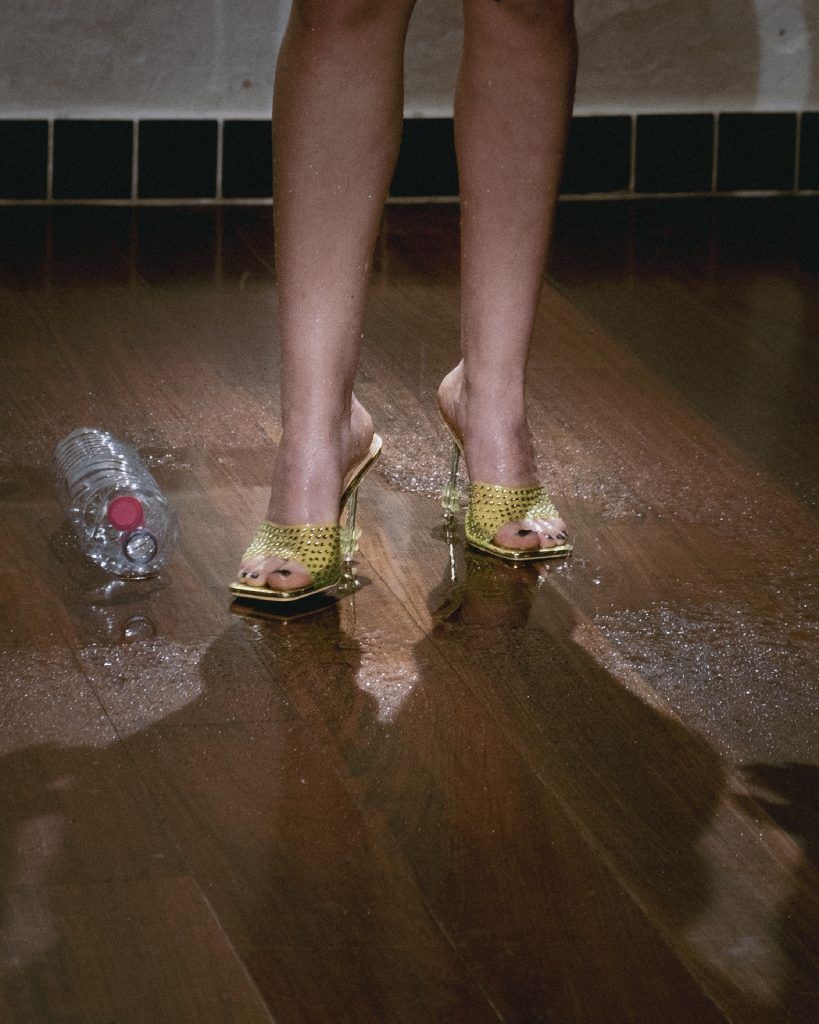
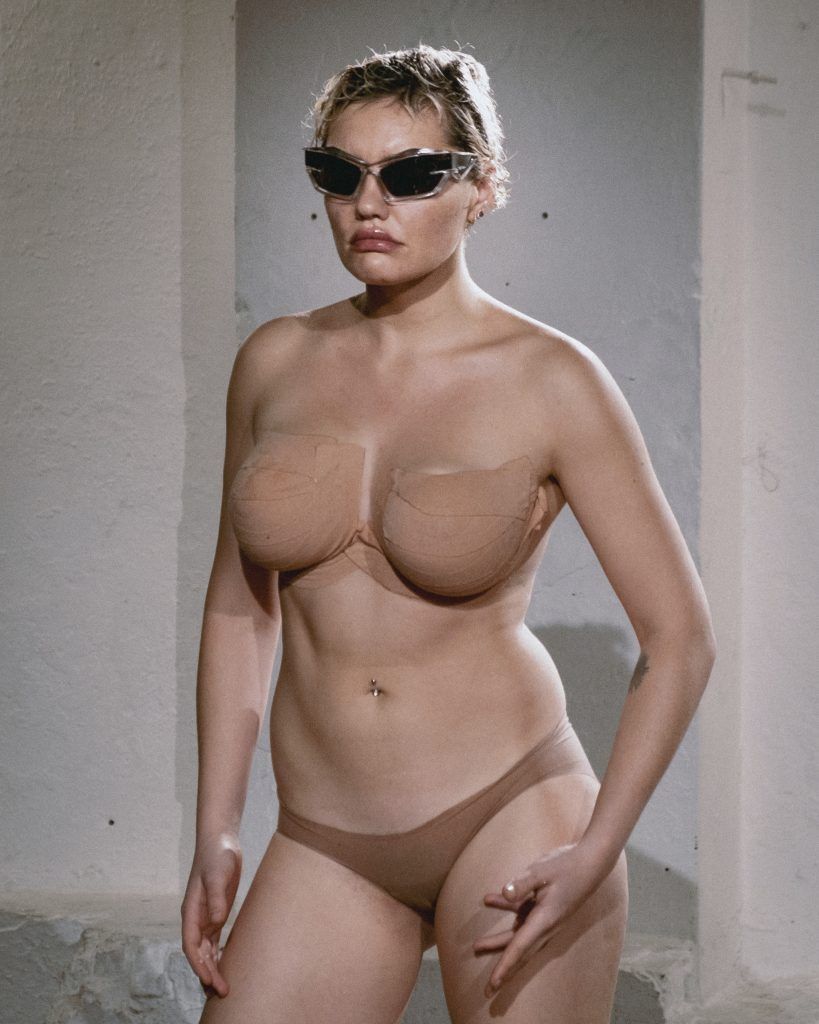
juliette: I think the physical prosthetics help a lot. Wearing heels, for example – I work with concrete elements to access a sense of an augmented self, or a different presence. It’s a bit like drag: by slightly diverting or exaggerating certain aspects of yourself, you enter another mode of being, something beyond the everyday. I trust these tools – my glasses, the wig, the tape, the heels. They shift something immediately. I’m no longer just going to the supermarket. What interests me is this possibility that the external, the superficial, can actually generate a real transformation. There’s a kind of double movement. On the one hand, there’s the idea of an internal presence – something more intimate or mysterious – that diffuses outward, almost like a seductive force that leaks into the space and draws others in. On the other hand, I’m interested in how these external, surface-level elements are absorbed inward and produce a certain feeling or state of being.
At the same time, I’m very occupied with specific references. In the song I sing, I work with this “chopped and screwed” collage of songs – done analog, with my voice. I’m layering these fragmented samples while following a physical score of micro-poses and subtle movements. The image it produces is something like a soft flesh cyborg. I’m constantly making small adjustments : to my balance in heels, reorganising the body, modulating the voice – projecting just enough. It’s not an automatic score, not like repeating a script. It remains slightly difficult and unknown. And I hope that within this tension I experience internally” the comfort and discomfort – a certain presence can emerge, or diffuse itself.
I’m not sure if I’m seducing the audience. But I’m very interested in how seduction works. Sometimes it’s intentional, but often it’s more slippery, less direct. There’s a kind of displacement: maybe you seduce precisely when you’re not trying to. If you try too directly, it becomes something else, almost like acting. It’s similar to an actor’s method – you don’t think “I am angry,” you work through the body, you tense up. That displacement is important to me; it’s part of the choreographic thinking. It’s not necessarily about succeeding, but it is about asking: does this work? I’m also interested in building a kind of relational tapestry of references. Beyond a reproduction of images, it’s about revealing how I’m influenced. The songs I use, and artists I reference – they are part of my understanding of seductive presence. I think of them almost as ghosts. You try to call them in, like placing your hands on a Ouija board, allowing something to speak through you. It’s not about becoming them, but about forming a dialogue – hoping to access some of that energy. For example, when I sing from Me & U by Cassie, it’s almost like I’m invoking a certain kind of sensuality. It’s a trick in a way: even if I’m not inherently seductive, by alluding to something that is, I might become so through association.
Imke: Yes, because the audience recognises these references. So you can play with the images and associations they already have in mind.
juliette: Yes, I feel that’s the field of seduction. It’s a space where we project many so-called innate or naturalised ideas, but actually it’s a space that is heavily commodified – shaped by codes of conducts, artifice, and lots of effort. It’s a constant giveaway, of the fact that we’re not really spontaneous, or natural.
Imke: You are saying we are not natural, and earlier you used the term soft cyborg. Many transhumanist ideas are centred on technology, whereas your notion of the soft cyborg seems to involve a coupling with nature. Could you speak about how you developed this idea of the soft cyborg, and about your particular relationship with squashes?
juliette: In general, I’m very drawn to fruits; they’ve often been used as sensual bodies. There’s a long visual history of fruit as a symbolic embodiment of something sensual or sexual. It’s hard to explain why I’m particularly obsessed with squashes, but I’m very visually attracted to them. They feel joyful. When I started engaging with them artistically, I realised that part of the attraction comes from their form. They embody something sensual, even sexual, in their shape – something that recalls both ancient, Venus-like sculptures and more contemporary forms. You see it in these prehistoric figures, like the Venus of Willendorf, but also in sculptures of Niki de Saint-Phalle – this recurring language of rounded, curving bodies. But also, I think the butternut squash specifically, holds a duality: it can resemble both a curvy, “feminine” shape and a phallic one. It contains both at once, and that coexistence is what I find exciting. It opens up that erotic space, but also expands how we might think about gender – not by removing gender markers, but by fully inhabiting them. In my daily life, I tend to move away from strongly gendered identification – towards something more neutral or in-between. But the butternut squash feels different. It’s not non-binary; it affirms both sides at once, almost excessively. It stretches out binary to the point of undoing it – by inhabiting it in a maximal way. That’s what interests me. Squashes to me are bodies that feel strangely autonomous, even excessive. This makes it easier for me to practice embodying a fantasy. I’m trying to embody myself through the way I perceive the squash. Incarnating the self through other bodies, or invoking specific body parts.
That’s the patchwork presence, becoming a kind of prosthetic composite – assembled from different bodies and references that amplify my own landscape of seduction – and see what happens!