
OF VALUE
A conversation between Ama Rouge and Valerie Ebuwa
Valerie Ebuwa and Ama Rouge | May 2026
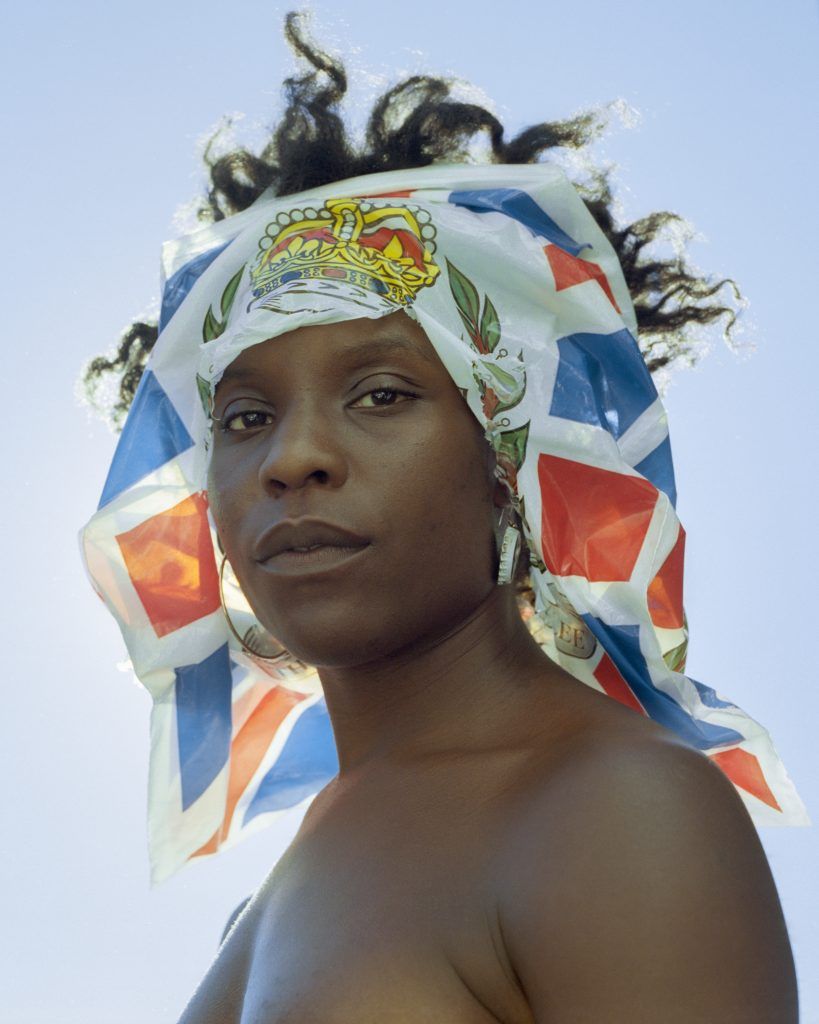
In response to this chapter’s theme, Vision and Flesh, which examines how dominant visual regimes rooted in patriarchal and colonial value systems shape and delimit our gaze, Moving Discourse is pleased to present a transcript of a conversation held in September 2022 at Siobhan Davies Studios, London, between choreographer Valerie Ebuwa and artist Ama Rouge.
The discussion focuses on Ebuwa’s work ValUE, developed through the Siobhan Davies Artist Archive programme 2022/23. ValUE reclaims the Black female body – working with and through the body to offer an image of Black womanhood that resists objectification, exoticisation, and sexualisation. In foregrounding the continued exclusion of women of colour from Western art history, the work poses a series of urgent questions: Who creates the archive? Who shapes the canon? Who is granted visibility, and under what terms? By addressing the entanglement of power and visibility, ValUE exposes the structural origins of intersectional discrimination – conditions that Ebuwa, as a Black woman, must still navigate.
Attentive to this longstanding asymmetry in representation – and to the fact that, even when represented, marginalised subjects often do not own their images or their archives – Moving Discourse is committed to bringing ValUE into renewed visibility. This attempt coincides with Siobhan Davies’ transformation of the work into an online exhibition as part of their ongoing inquiry into “what an archive can be and who gets to have one.” Access this newly created exhibition here: https://www.siobhandavies.com/programme/artist-archive/value-archive/
Editor’s note: This text is not a full transcript of the conversation between Valerie and Ama. “[…]” indicates sections that have been omitted.
Rouge: Val, how did all of this begin?
Ebuwa : I think it began in 2018. I was really sick and tired of being in companies and not feeling that I could be myself or present myself – and I really wanted to know why.
Why was it that I could be in the companies I wanted to be in, and yet I didn’t feel like I could be myself? And I was also wondering: why did joining these companies with well-established dancers not give me the financial gain that I thought would come with it?
So what I was doing was dancing in companies and, on the side, working as a life model because it gave me a bit of cash cash […].
When I was working as a model, at the end of each session, you go around and look at all the images. I always noticed that people couldn’t really draw me properly. They did get my skin tone wrong or my nose would be super straight or super thin – my features just weren’t right. It just wasn’t me, basically.
When I would ask the artists questions like, “Oh what happened”?, they would say, “Oh I did not quite get that right.” And I would respond, “Why do you think that is”? Then they would usually go bright red because they realised they had never drawn someone who looks like me or has my hair texture or my features. Actually, they were just drawing on autopilot.
I realised that when I close my eyes and think about the most famous portraits or images, all these white images come into my mind: The birth of Venus, The Mona Lisa, and so on. Then I started thinking about the 15th century, the Italian Renaissance, and how those ideas are still held today – this idea of the silent muse, who never really gets to tell a story. They are only depicted, and the artist in question receives all the glory for the image.
I realised that those two things, which are prevalent in the art world, are also present in the dance world. Choreographers place movement onto you, or maybe you even create the movement, but in the end it is the choreographer who is understood to be the artist, and the dancers are just seen as bodies.
So I wanted to do some research and make a work about that, because I thought it is really important to identify, when this historically started. When did it begin that we essentially got robbed? Because the only way we can solve these things is by knowing what we are actually trying to solve.
Again, The Mona Lisa is the most expensive art piece ever to be made. But who really knows about this woman? We see the image, we know about Leonardo Da Vinci, but we don’t really know who she is, or what she is about. So I was wondering whether I could do a project where we are in conversation about the relationship between artists and muse.
So everything started then, in 2018. I was doing it in my spare time because I was still dancing for companies and working as a life model to try to be financially secure. It started because I was really fed up that people only saw my body as “xyz,” simply because they have never been taught to actually look at me. They have never been taught how to draw or capture me.
Rouge: Why was it important for you for it to be exhibited here, at Siobhan Davies Studios as part of the Artist Material Archive ?
Ebuwa: Firstly, it is a tricky situation, because institutions are inherently racist — they are built on white supremacist ideals. So when you exhibit work as a Black person, there is this constant dichotomy of knowing how much to really give.
When I had finished the project, I was really thinking: “Hmm I don’t know who deserves this, whom I should give this to, or who I should maybe work with.” I wasn’t writing any funding applications because I felt that people did not deserve to have that work — this archive in particular. First of all, this archive is an archive of my body — a Black female body. Many other archives I’ve been involved with have been created by white people archiving the body. Black bodies, in general, in general, are often archived without being owned by the Black people within them. So I felt it was important to create a Black female archive owned by a Black female artist
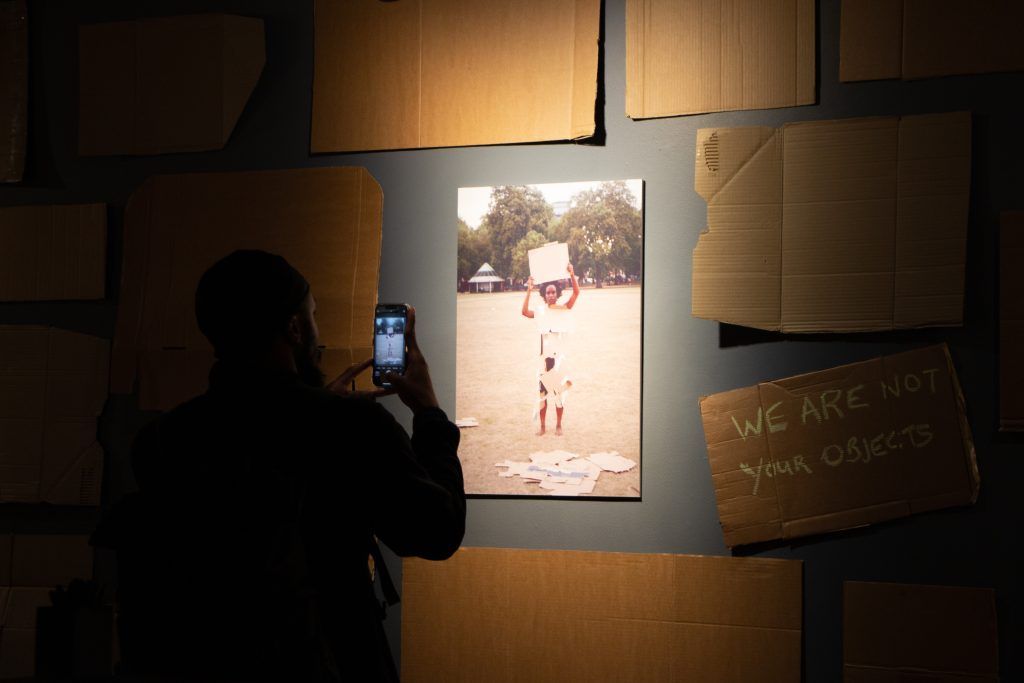
Rouge: Some people may have heard Valerie on many many podcasts. Ellen and I are co-hosts of the PowerUp podcast and we were really fortunate to have Valerie as a guest last year as part of a series we released on enduring and resistance.
We had a really frank conversation, and you spoke a lot about unlearning internalised other people’s opinions about you. I’m sure this is something a lot of us are working through and have to navigate – some more than others.
You said, and I quote : “Resistance is a part of my identity – period.” And it is very clear to me, and I’m sure to many others in this space, that ValUE is not just a project – it is a movement. It is an act of resistance; it is activism for Black women.
What I want to know beyond that is: how much of this project is personally for you, for Valerie? And how much of the project is for what we don’t see?
Ebuwa: That’s a very good question. I think it is a lot more for me than I even realise. For those who don’t know, the work is called ValUE because my name is Valerie Uchechukwu Ebuwa. If you take the “Val” from Valerie, the “U” from Uchechukwu, and the “E” from Ebuwa, it becomes ValUE. Well, I don’t think you can name a project after yourself and then be naked on top of that – at least for the most of it – and have it not be for you. I think that, in order to really find out about myself, I have to – maybe not push myself to the limits, but —
Rouge: Maybe move past of what is comfortable?
Ebuwa: Yes, absolutely! […] I think the work is actually for me, because I’m forcing myself to look at myself, and I’m also forcing other people to look at me too. And I think it is for me because it exists as a material archive.
When I was eight years old, I used to run into the garden and just pick up anything – sticking leaves together or whatever — and say, “Oh mum, look, I made a fishing rod!” I made all these random things, and I feel like for this work I’ve been able to play again.
Using all these materials makes my eight-year-old self so happy. It’s like telling her: you did it, you made it. You were laughing back then while making that fishing rod – but look at you now.
Rouge: That’s important — to be able to continue making the work that you’re used to making, really embodying your creativity. And we were talking earlier, about the fact that we are multidimensional, and that you are multidimensional. Often, Black females and Black people are assumed to be quite monolithic, and it is really important to show: no, we are not all the same — I can encompass all of this and all of that.
Part of that is also tapping into the eight-year-old Valerie and allowing her to just be, and to see what she needs in order to blossom. And the outcome is that we get to enjoy this — we can converse, grow, and unlearn, in order to learn, rebuild, and empower ourselves, right?
I was wondering: how does this body of work tie into your choreographic and performance work?
Ebuwa: For me, it’s all the same, if I’m really honest. I’ve trained as a dancer but I also really like to write — and when I write, I don’t think of it as a different thing. This might sound a bit cheesy, but I feel like I’m choreographing words. It’s me using my dance lens to produce something that isn’t dance, if that makes sense.
Even when I was making the earrings for this work, it felt like choreographing. For me, it’s all the same — it’s just about the lens in which you look at it, or the way you frame it in your mind. I don’t see these things as different.
And actually, sometimes when I’m writing, I start thinking about how I move. A lot of the time, I do other things to generate ideas that I can then bring back into the studio and into the body.
Rouge: I know that there is a lot more work around ValUE – are you able to tell us, as a kind of closing, a little bit more about the ValUE framework?
Ebuwa: The ValUE framework is a creative framework to navigate systems. I developed it based on my experiences, but basically it is a toolkit or a framework to help Black dancers, in particular, to be able to navigate the dance world or the art sector.
There is so much about the sector that we, as Black dancers, often don’t know. Sometimes we encounter certain situations where the industry can feel really lonely, and you don’t know what to do. If you are in a situation where you feel exploited, and you are the only Black person in the room, it can feel incredibly isolating. You might try to reach out to friends, but they may not know what to do either – because they are also that Black person, alone in the room.
So I have been working on this framework with a list of signposted support – such as pro bono resources, including lawyers – and guidance on things like grievance processes.
It also includes reading and learning. Often, anti-racist texts that are widely references include writers like Reni Eddo-Lodge and Audre Lorde. But real anti-racism is also about experiencing our joy — reading Black literature, going and seeing Black films, and engaging with Black creativity in all its forms. It’s not just about the struggle
So I created this framework to help people navigate the world – specifically the dance sector, but it can be applied to almost any industry. And that’s really the value of ValUE: to find value in yourself and knowing that you are of value.
[…]