
shot softly
In conversation with Vincent Tiberius
Vincent Tiberius and Imke F. Gerhardt | May 2026
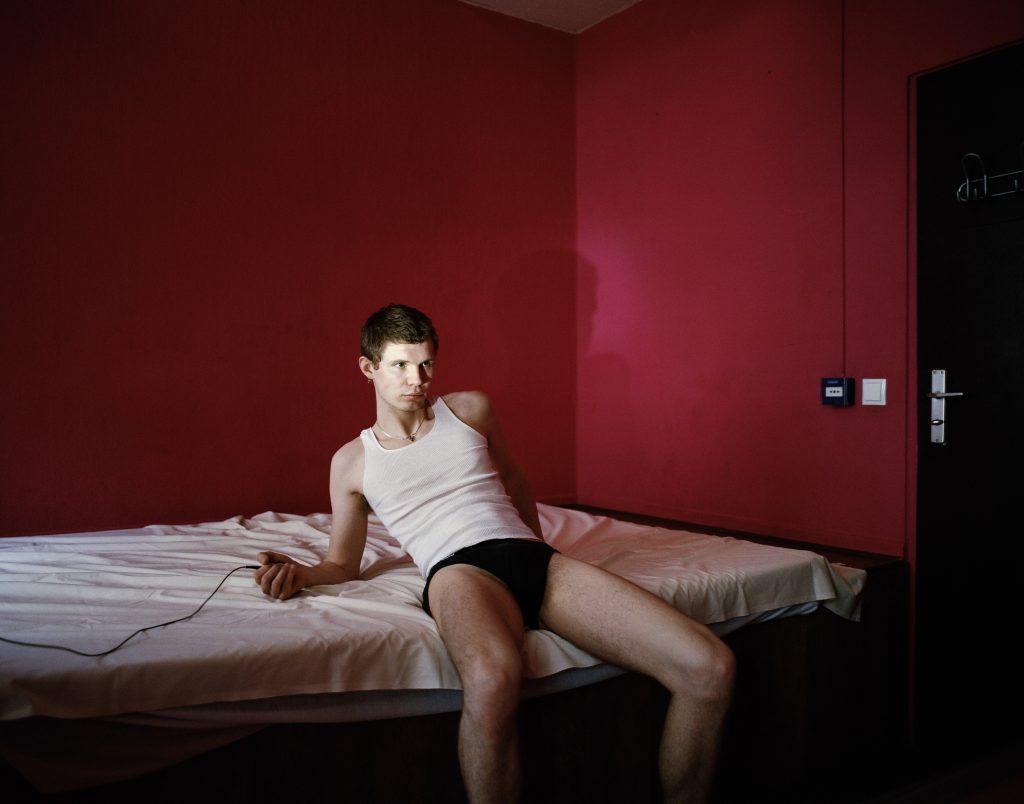
A quiet that speaks of proximity, as if the person before the lens had yielded to it. An approach toward the other – an entry, marked by tenderness.
The photographs of Vincent Tiberius – intimate portraits of queer communities and queer sex workers – carry precisely this stillness and care. They bear witness to closeness and trust; they register the textures of the everyday.
How might marginalised bodies be made visible through photography without reinscribing the conditions of their hypervisibility – that paradox of being perpetually exposed and yet structurally unrecognised? In conversation with Vincent, we turn to the ambivalence of visibility, and to the ways photography operates in the shifting field between representation and projection.
Often assumed to be a neutral medium of documentation, photography produces its own truths. It delineates norms and deviations, participates in typologies, and risks fixing its subjects as objects. And yet, it can also remain soft: carried by a gaze that does not harden into contour, but lingers, shifts, and leaves space for imagination. Vincent speaks to this possibility from a deeply personal position.
Imke: I would like to centre our conversation around the notion of visibility in all its ambivalence – visibility as it operates between representation and projection, and, crucially, visibility as it relates to recognition. Drawing on Johanna Schaffer, one could speak of hypervisibility as the paradoxical condition imposed on marginalised bodies: overexposed and yet structurally unrecognised, rendered visible while remaining illegible within dominant regimes of meaning.
Your work engages precisely such bodies – queer communities, queer sex workers – through a mode of intimate portraiture.
How does this form of recognition emerge in your work? Is the potentially intimate process of making the image – particularly the proximity between photographer and subject – a necessary condition for this?
Vincent: For me, it’s not only about proximity, but more than anything is about being an insider. Especially in contexts like sex work, people trust me because I share their experiences, I understand their language, their highs and lows, and that mutual recognition creates an immediate bond. When I photograph in intimate spaces, like parties or someone’s home, I am not an outside observer, I’m part of the scene, as exposed and involved as the people I photograph. I never try to portray something I wouldn’t live myself. I see photography as a way of understanding myself and others, grounded in the belief that real understanding requires closeness. I’m drawn to people who reject systems and live authentically, in their presence, I feel both comfortable and seen. In this sense, my practice becomes a form of relational proximity that resists hypervisibility, creating images that allow for complexity and openness, where people are not reduced to a single, fixed meaning.
Having published two books and currently working on another, I’ve come to realise that words matter. Context matters. It can open someone’s eyes before they truly see what is in front of them.

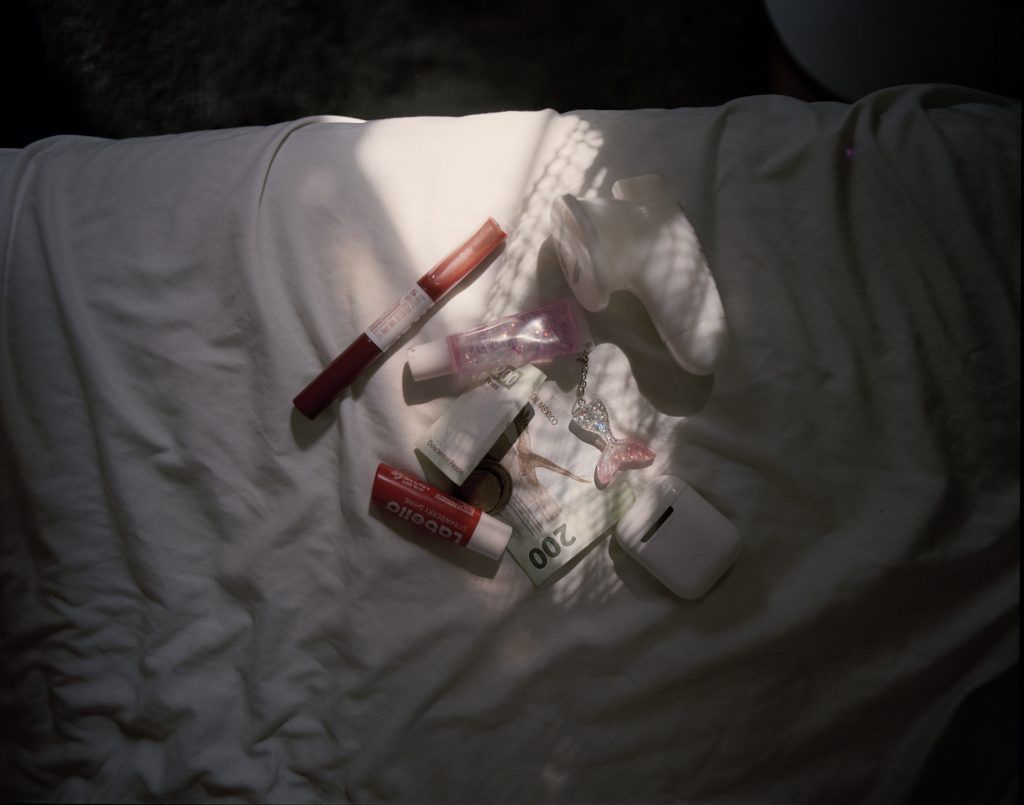
Imke: Queerness, within dominant image economies, tends to appear stereotypically as spectacle: excessive, loud, and immediately legible. In your images, however, I perceive a sense of stillness – one that produces a particular depth. These portraits exceed mere depiction; they operate more as a reflexive practice of representation.
Following Antke Engel, one might understand images as “agents of governmentality” – a term that goes back to Michel Foucault. Foucault has shown how power operates not only through prohibition but through the productive regulation of bodies – through what he terms biopower and, more specifically, the dispositif of sexuality, in which sexuality is continuously incited, codified, and administered. We are currently witnessing the violence of these regulatory mechanisms in the resurgence of explicitly anti-queer politics. At the same time, sexuality circulates in a hyper-mediated, often spectacularised form – higly visible, yet flattened into cliché.
Precisely in their stillness, in their quiet reflexivity, your images seem to operate as subversive agents within this regime. What do you think produces this sense of stillness in your portraits? Could stillness itself function as an aesthetic and political strategy of resistance?
Vincent: I think the stillness comes from the way I relate to the people I photograph. That creates a different kind of energy. Less performance, less about being perceived or read, and more about simply being. The camera becomes less of a tool of exposure and more of a space of encounter. So yes, I believe that, stillness itself function as an aesthetic and political strategy of resistance. It allows for moments where nothing has to be proven or explained, where people don’t have to perform identity. When the mask falls away and only the person themselves can be felt. It’s about showing humanity, vulnerability, and everything that connects us.
That’s also why I try to anchor my projects in something universal, some kind of hook people can immediately relate to. Because in the end, everyone gets ready for something, everyone has a butthole, and everyone wants to be seen and understood.
Imke: This stillness might also emerge through a certain simplicity or mundanity. By portraying queer sex work as part of everyday life, your images seem to articulate a gap between stereotypical projection and lived reality. The apparent simplicity of these images seems to underscore their claim to truth.
At a moment when images can increasingly be generated through AI – detached from any indexical relation to reality – the relationship between image and truth is shifting.
Are you interested in photography as a form of registering reality – as a document of truth that insists: this is the mundane reality of queer lives? Where do you position you work between construction and authenticity, between documentary truth and erotic imagination?

Vincent: I think that’s a really interesting question, especially because, as the photographer, I inevitably shape the image through my own perceptions and ideas. Even if I try to step back, it remains my way of seeing the world. At the same time, the situations I photograph are grounded in lived reality, they come from my own life and the communities I’m part of. The stillness and mundanity you mention come from that familiarity. These are not constructed ideas of queer life or sex work, but moments that feel ordinary from within, even if they are often perceived differently from the outside.
There’s also a tension in how images function for the people I photograph. For many sex workers, especially those promoting themselves online, their image is directly tied to their income. When preparing for shoots, I was aware of that. But none of them ended up using the images I took of them. That gap points to the difference between images made to circulate for clients and those that emerge from a shared space rather than to perform or sell something.
So I don’t see my work as a straightforward document of truth. It exists somewhere in between, between construction and authenticity, between documentation and projection, between intimacy and imagination. I’m not trying to fix reality, but to stay close to it while acknowledging how it is always mediated.
With the rise of AI and image generation, I think this becomes even more relevant. What might start to matter more again is not just what an image shows, but who is behind it, whether there is a real connection, a shared experience, a story told from within rather than imposed from the outside.
Imke: Your mode of portraiture suggests a certain ethics of attention: the camera not as an extracting device, but as something closer to a caress – soft, attentive, intimate.
This is particularly striking given the historical entanglement of photography with regimes of violence. From the 19th century onwards, photography functioned as a central instrument of typologisation, producing visual taxonomies of deviance and normality, and thereby naturalising regimes of difference. As Johanna Schaffer, drawing on Allan Sekula, has argued: the photographic archive itself operates as a system of ordering – one that renders difference visible as fact.
Against this historical backdrop, your work can be read as contributing to a queer archive. Given that practices of memory and historiography are always deeply political – structured by power and marked by exclusion – to what extent do you understand your photographic practice as a form of subversive counter-memory?
Vincent: Very much so. I often find myself in beautifully absurd situations, surrounded by people who are incredibly open and unmasked, people who have rejected established systems and are living in ways that feel true to themselves. I feel a strong desire to hold on to those moments, to document them without fixing or reducing them.
In that sense, my work naturally moves toward something like a counter-memory. Not in a grand or institutional way, but through small, intimate fragments that might otherwise disappear. Through my projects, and especially through print publications, I try to preserve these glimpses for the future. They form a kind of quiet archive, one that doesn’t classify or define, but stays close to lived experience.
That’s also why I’m so drawn to photobooks. They can travel across time, be revisited, reinterpreted, unless, of course, they are destroyed. But even that fragility is part of it. It reflects how precarious these histories often are, and how easily they can be erased.
So yes, I do see the work as a form of counter-memory, not by opposing dominant histories directly, but by creating space for other ways of being, remembering, and relating to images.
Imke: For me, the caring softness of your images operate as a punctum in the sense described by Roland Barthes – the affective rupture within the image, the detail that “wounds” the viewer and establishes a singular, intimate connection. At the same time, the photographic portrait always testifies to an absence: the body depicted is no longer present in the moment of vieweing, yet appears to us as if it were. Photography thus holds a peculiar temporal power – it recalls, re-activates, and render something present.
As much as you take intimate portraits of others , you also portray yourself.
How significant is this practice for you as a form of personal memory? To what extent is your work not only about establishing a relation to others and to the past, but also about forging a relation to yourself – one that is potentially future-oriented and constitutive of identity?
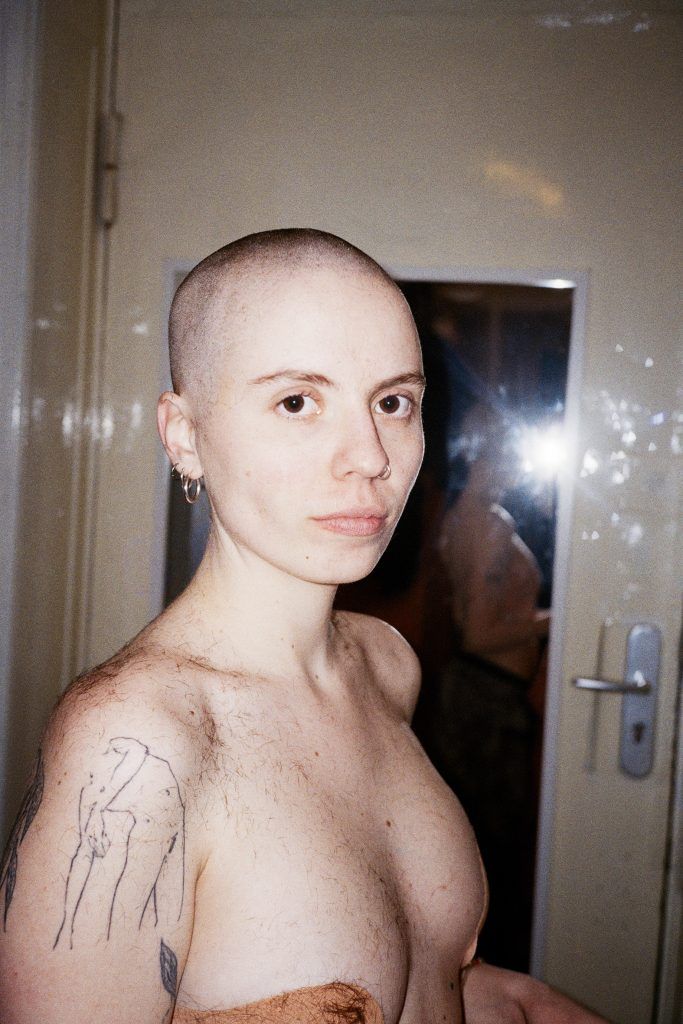
Vincent: I’ve always had a complicated relationship with my body from competitive sports as a child to drug excesses as a young adult. For a long time, my body felt like something I had to shape or achieve, rather than something I could simply inhabit. I think it’s not a coincidence that I only started portraying myself once I began to appreciate my body more, although that appreciation is still entangled with ideals, and now also with a sense of impermanence. That shift happened around the first year of the COVID pandemic.
In that sense, self-portraiture has become a way of relating to myself, and also of holding on to something. Maybe my own punctum, in the sense of Roland Barthes, lies in those moments where I see myself and, unexpectedly, feel a kind of happiness or recognition. There is something intimate and slightly narcissistic in that as well, especially because I often appear half-naked or naked.
At the same time, my sister, Flora has recently started documenting me quite a lot, which adds another layer. It shifts the perspective and complicates the idea of control, how I see myself versus how I am seen by someone close to me.
So yes, I think my work is not only about creating a relation to others or preserving moments for the future, but also about negotiating a relationship with myself. There’s a desire to remember who I am, or who I might have been. And it’s funny, because while I often speak about authenticity in the people I photograph, I realise that with myself I’m still navigating a tension. I’m constructing, selecting, sometimes staying on the surface. Maybe that’s part of it too: understanding that identity is never fully fixed, but something that keeps shifting between image, memory, and projection.