
Tender Biopsy
Exploring the liminal nature of skin
Alexandra Bierlaire | May 2026
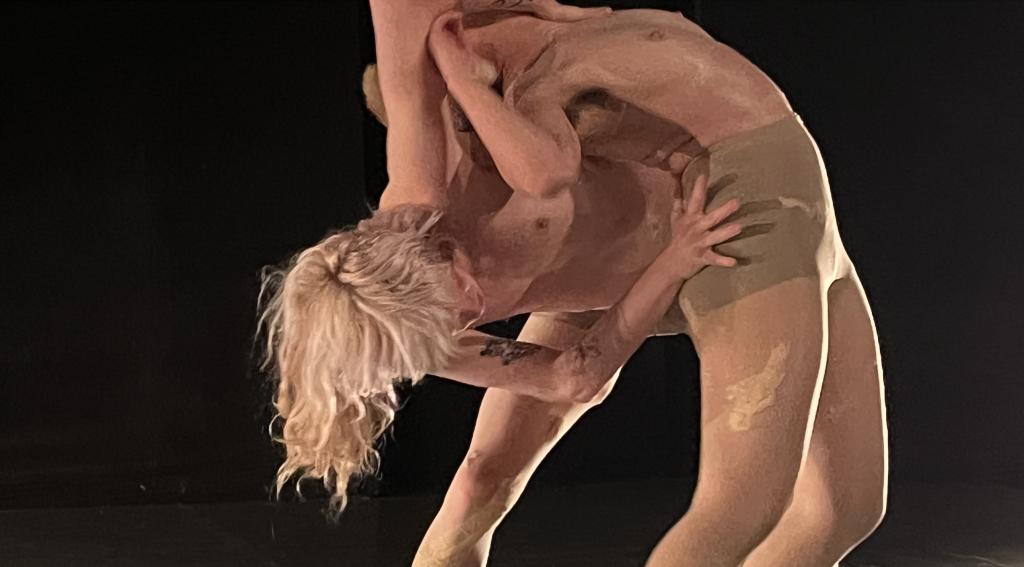
In Alexandra Bierlaire’s choreographic work, the skin becomes both a physical and conceptual entry point for exploring embodiment, relationality, and the tension between interiority and exteriority. Rooted in a profound anatomical curiosity and attentive to the materiality of our largest sensory organ, their practice moves between the tangible and the philosophical. By engaging with the skin as a liminal surface, Bierlaire investigates how it acts simultaneously as a point of contact and a boundary – mediating our sense of self, our relation to the external world, and our encounters with others. While it protects what lies beneath, the skin also exposes us, making us vulnerable and alert to touch, perception, and movement. In Tender Biopsy, the choreographer reflects on this process, revealing the skin as a sensory and expressive surface, and as a site of inscription that embodies and refracts the social and historical contexts in which we live.
Having trained as a dancer and tattoo artist, I realised that my skin was the first thing that touched the world. I started to wonder, how can I reclaim the materiality of skin within my performance practice? How does focussing on the materiality of skin deepen my awareness as a dancer? What new connections could arise? What clarity could I gain?
In this text I will document the process of reclaiming the materiality of skin as a living boundary between the inside and outside. I will describe, how I explored this semi-porous membrane together with my dancers in the studio. How we used liquid latex as a tool to expand the body. And how we played with the principles of Contact Improvisation to eventually develop an ethical practice of touch.
Touching is being touched
Our biggest organ is in constant regeneration, following and growing with us, holding scars as memories, materialising time and personal history. But the reading of the recording that is skin is open to numerous socio-cultural interpretations (Prosser, 2001, p. 60).
Skin is the liminal space, where negotiations happen through touch, allowing bodies to meet and evolve. Because touch is a foundation in Contact Improvisation, I wanted to infuse my research with theories and principles from it. I encouraged the dancers, Annarose Atamian and Silas Grocott-Cain, with whom I was working at that time, to improvise in contact with each other. The first improvisation was based on the theories of French phenomenologist Maurice Merleau-Ponty (1968), who observed: when I touch the other, I necessarily touch my own body.
We started to look at this from the perspective of having sensory information from two perspectives: the inside and the outside of the physical boundary. This led us to discover a shift in the dancers’ focus, allowing new forms of visualisations. We realised that putting emphasis on observing, whether the sensual information was for/from them or the other, lead to completely different movement decisions and intensities. As a choreographer, I could sense that through paying attention to the way the dancers were meeting the skin, different qualities of movements occurred and new narratives about the possibilities of relationships were written.
I developed a score, filled with words, which derived from the qualities of the materiality of the skin, aiming to translate those qualities into movement : pushing, pulling, twisting, extending, brushing, gripping. I wanted to question boundaries and explore the fragility of a movement. Going to the limit, the unknown. Failing in order to start again.
Like Contact Improvisation in general, I was interested in the feeling rather than the shape. This focus on the internal perception instead of a precise external position, required not only a certain level of mental and physical readiness, but also the development of an ethical conduct.
Based on the discussions we had and discoveries we made in the studio, my aim was to develop my own ethical practice of touch, to at least understand a tiny bit about what the mysterious power of touch changes in our body.
The ambiguous nature of touch, the unclarity it can leave behind, made me look into discussions about how negotiations take place in Contact Improvisation. Observing the dancers in the studio, I wondered how they were making decisions without speaking. The negotiation was happening physically, through developing an awareness for what they could sense of each other through the skin. Because of the nerves being embedded in the skin, they are able to make choices linked to proprioception, which is our ability to sense movement and location. Thus, our discussions in the studio, were happening with different means of communication, through the shared physicality of bodies. It required a physical listening and a certain level of curiosity: curious to follow each other into the unknown.
Curiosity, in the context of Contact Improvisation means, approaching a situation without assumptions of what it is and with an openness to discussion. This training allows dancers to develop the flexibility to respond in the moment. And it trains us to pay attention to details from each body within our kinesphere, inside as well as outside the studio.
I believe that paying attention to the skin unlocks presence and capacity to respond: “This is the fruit of kinesthetic attention, a physical mindfulness that prepares one for improvisation” said Contact Improvisation practitioner Ann-Cooper Albright (2013, quoted in Bjerre-Jensen, 2020, p.116) As the first space for communication “skin gathers experience and exude” it is living and dead, skin is self-repairing, self-replacing, sensual and sensing” (Manning, 2007, quoted in Bjerre-Jensen, 2020, p.115)
Putting emphasis on sensing and listening made me decide to stick with a score and not develop a fix choreography, as my dancers as well stated that a choreography would pre-empty the feelings and sensations they were seeking. In this context, only a score, based on improvisation, allowed them to use touch in order to have an ongoing discussion and make impulsive decisions.
This constant listening and witnessing of the other, which is required in this form of practice, allows us to really see, and not project, who the other is.
The materiality of skin as liminal
The term liminality was first coined by the French ethnologist Arnold van Gennep, describing “[…] an intermediate ritual phase during initiation, in which initiates can be considered either sacred or potentially polluting to the mainstream society because of their anomalous social position. New social rules are commonly taught during the liminal phase, and strong, endearing, and creative bonds often develop between fellow initiates. ( Oxford Reference. 2015). Eventually, Victor Turner developed the concept to fit broader liminal states as of being in-between, in transition between states or places. ( Wels et al. 2011, p.1)
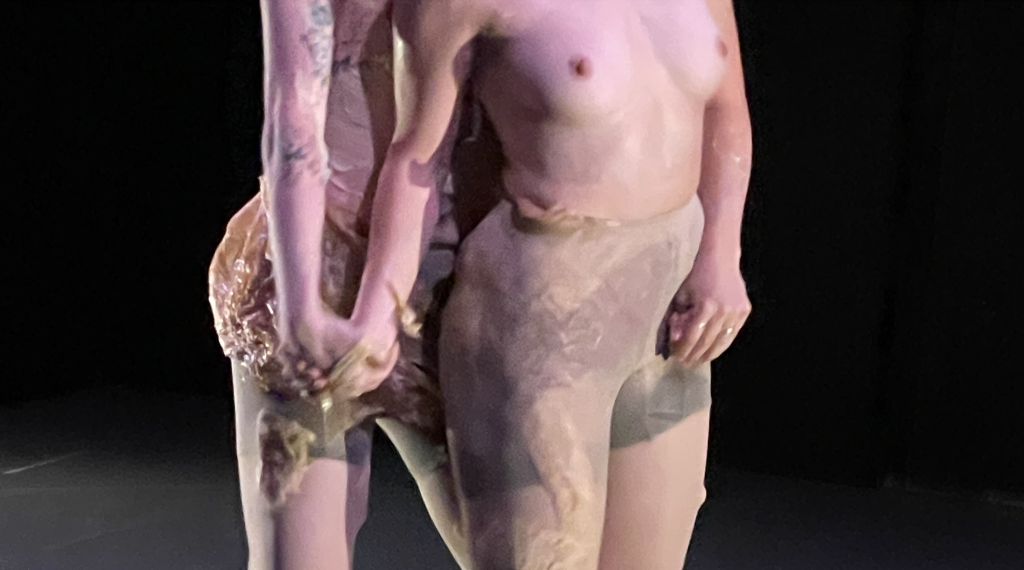
The transitory nature of the skin, this in-between place, where the inside meets the outside, made me realise that the skin is liminal in itself. The skin is simultaneously surface and depth, a semipermeable membrane from where sweat is expelled and actives can enter; a liminal place between inside and outside but part of neither. (Pitts, 1998, quoted in Watson, 2010, p. 36) Going back to the roots of the term liminality, it is interesting to note that it was first used in the context of ethnological studies on rituals. Although my research is not about rituals in particular, elements of my research could be considered ritualistic and are consequently implying a liminal phase. In particular, the application of liquid latex during each session, which allowed us to dig into the materiality of skin had a ritualistic character. By applying liquid latex directly on the dancers’ skin, I use it as a tool, an in-between reality and artefact.
Using latex to research skin is interesting for its similarities: visual quality/texture, malleability, elasticity, tactility and connotations; indeed, latex is often associated with erotism and BDSM practices, where I learned the importance of setting boundaries. I apply latex in a way that the material is fragile yet powerful, allowing one to make comparisons with the skin. Through regular practice, I realised that the unsettling feeling that can be part of being in a liminal state fades out with repetition, becoming an end in itself. – [when a liminal activity is done repetitively] the activity becomes familiar and gains structure.” (Simpson et al., 2010, quoted in Parvez, 2024)
After exploring the semi-permeable membrane on each other, I invited the dancers to explore their skin as a boundary to the outside, paying attention to how we relate to our environment and how this environment enters the body. Mucous membranes such as eyes and lips can be opened and closed, giving the choice, whether outside information can enter the body or not, whereas nostrils and ears are mostly permanently open. The dancers observed what information entered their body and what journey it took inside the skin. For example, they received information through their eyes, then decided to close them, stopping the information from flowing. They did the same with their mouth. This task was supposed to reframe the focus: seeing their skin as an envelope to their body, similarly to visualising air entering the body in meditation. From this exploration the dancers developed a greater awareness of their physical boundaries and where exactly they stop, allowing them to play, construct and deconstruct.
What I learned in my research is that touch is a beautifully sensual form of communication. A form of listening and engaging with our surrounding, a sensitive form of negotiation. Embodying and witnessing the materiality of skin allows the dancers to switch the focus position, internal or external, or where the two meet creating communal energy through touch (Peake, 2019, quoted in Partridge, 2019). Touch is “language that communicates with other people, other bodies and also other fields of consciousness.” (ibid.) Touching and being touched, is like allowing the body to expand in space and sensing, how this space enters and moulds the body, too.
Endnotes:
Bjerre-Jensen, D. (2020) “Facilitating thinking-touch through process philosophy and contact improvisation” in Sarco-Thomas, M. (ed.) Thinking Touch in Partnering and Contact Improvisation Philosophy, Pedagogy, Practice. Newcastle Upon-Tyne: Cambridge Scholars Publisher, pp.104-128. Available at: https://www.cambridgescholars.com/resources/pdfs/978-1-5275-5363-7-sample.pdf
Merleau-Ponty, M. (1968) The Visible and the Invisible. Translated by Lingis, A. Evanston, IL: Northwestern University Press.
Partridge, R. (2019) Bodily Intelligence: An Interview with Florence Peake. [online] Berlin Art Link. 25 Jan. Available at: https://www.berlinartlink.com/2019/01/25/bodily-intelligence-an-interview-with-florence-peake/ (Accessed: 4 Aug. 2024).
Parvez, H. (2024) Liminal Space: Definition, example, and psychology. [online] PyschMechanics. Available at: https://www.psychmechanics.com/liminal-space/ (Accessed: 5 August 2024).
Prosser, J. (2001) “Skin Memories” in Ahmed, S. & Stacey, J. (eds.) Thinking Through the Skin. New York: Routledge, pp. 52-68.
Watson, A. (2010) Complexion: skin, surface and depth in contemporary art practice. Masters Dissertation. University of the Witwatersrand. Available at: 39667813.pdf (core.ac.uk) ( Accessed: 5 July 2024).
Wels, H., van der Waal, K., Spiegel, A. and Kamsteeg, F. (2011) Victor Turner and liminality: An introduction. Anthropology Southern Africa, 34(1-2), pp.1–4.