
The Critic
Lindsay Dreyer Jude | May 2026
The following text is not a dance critique but – within the context of Chapter 2, Vision and Flesh – a commentary on the critic’s gaze; that is, a meta-analysis of the very framework of evaluation. What is the purpose of criticism today, and what does the epistemological structure from which judgement arises look like? In Moving Discourse, the writer and performer Lindsay Dreyer poses these questions – at once philosophical and political – in order to rethink and re-situate dance critique and her own role as a performer and dance critic in the present.
Questioning one’s own positioning – observing how, from where, and through which voice the “I” speaks – is more critical than the normative judgement of “the” critic. It is more critical, because it exposes how the norms that underlie any normative judgement come into being.
Michel Foucault, who illuminated the interrelation between knowledge and power, gave a lecture in 1978 titled What is critique? There he argues that critique does not stand outside society or above the object of evaluation. Instead, critique is a form of practice: a continuous self-questioning, a speaking from within power relations in order to make them visible. The difficulty of simultaneously performing within and observing the structures that shape our movements is addressed sharply by Dreyer, who is a performer and writer at the same time. In doing so, she demonstrates a talent for self-observation that enables her to critique the very structures from which her writing emerges.
In the intersection of my brain’s hemispheres, my internal critic sits with a sturdy pen and notepad that never runs out of pages. I am sometimes aware and sometimes forgetful of their habits, often mistaking their thoughts as guiding gospel. This becomes doubly hefty as I have chosen an artist’s career. My constant critic is emboldened by my professional experience with criticism, and refers to it often like a plaque on the wall: it’s all part of the process.
When I was hired as a dance reviewer while maintaining a career as a freelancer, I felt this inner critic stir. With Excitement? Eagerness? Confusion? Perhaps all three at once. It seemed to me a fine line between hypocrisy and doing my job. I tried to refer to the criticism I felt was helpful to me when I was studying, like comments about concept articulation, contrast, or clarity. Something to isolate myself from the inclination to ask myself repeatedly “who are you to take on this role”?.
“The Critic” is an entity. A perfect marriage of discernment and expertise. Collectively, we seek out knowledgeable counsel in every aspect: our health, our wealth, our safety. We want to trust those who offer us contributory judgement for our decision-making, so when we inevitably make a decision, we feel justified that it was the correct one.
It’s murky territory for subjective arts, as of course, all judgement would be subjective. Sure, framing a restaurant review in terms of universally accepted criteria like overall cleanliness and food safety is understood, but those aren’t the juicy bits. There is a craving for intense negative emotion, a soap opera being played out on the part of the consumer. In tandem with this “Critic” entity, it can seem questionable to participate in critiquing anything professionally.
What is it about taking on the job that creates such controversy? We are all critics, we judge, we have varying preferences and tastes and are happy to disregard things that exist outside of this sphere, sometimes with more vigor than others. The habit is there and socially emboldened by our increasing perception of being “public”. Our opinions can be posted with ease and there is no need or expectation that they be traditionally articulated. They don’t even have to be generally accepted as “good”: a “bad take” is equally as engaging as a compelling one, if not more so. The framework is there to feel emboldened by this career choice and find immense self-satisfaction: here I am, The Critic, respect my words and listen closely, what I have to say is loud and above board.
But my inner critic is still a critic in their own right, the two do not merge happily, and with their love of conflict, they fight bitterly. It feels so good to be “respected” in this way, but it shouldn’t feel too good, you narcissist, do you think you’re talented enough, knowledgeable enough for this? Still listen, listennn. And on, and on, and on.
The fight isn’t in my head, it’s real, and enforced by those around me. When I was discussing my new role to a highly respected teacher and choreographer in my community, their response was “oh I could never do that, I mean who am I”? Impostor, Pretender, False Idol.
The dialogue is too severe for what the job actually is, and even in my reviews I couldn’t escape a simple truth. Sometimes, I just didn’t like it. It wasn’t for me, maybe intentionally so, sometimes it just felt off, or I did. I am a person experiencing the work of another, and I will not and cannot align perfectly every time I see a body of work. It presents its own existential crisis. Still, a transaction of money-for-work has occurred, the stage is set and so I must perform—something of a nondescript nature.
The publication I worked for often offered two options for coverage to the companies we wrote about: you could write a preview, which would be published before the opening of the production and often included visiting a rehearsal or interviewing the artistic team; or a review, which happened after the opening night, and was ideally turned around before the run of shows was over, or up to two weeks after its closing date.
Almost without fail, the companies I would review wanted me to come opening night and get it published the next morning. I was not paid by these companies, nor was the publication, but if I wasn’t able to attend the premiere performance to make this deadline, it was not uncommon for the companies to request a different reviewer who could (which was also an impossibility due to the fact that the publication often sorted who would cover which show based on each writer’s availability for all the performance dates). If and when I would eventually receive my ticket to the performance, I would often also receive an email with “write us a good review!” added somewhere. All of this occurred in spite of our preview option, with its guaranteed turnaround time and generally positive and optimistic tone. But ultimately, a preview byline could not be added to program notes or a website and was less effective marketing.
For these companies, there was another role of “critic” that competed even with the two previously mentioned: as an eye-catching quote producer to push ticket sales and bolster reputation.
I feel now that “The Critic” exists outside of actually being a critic. You can play up the connotations of the role or not, but it remains a costume. It’s illusory and changes color in every light and for every spectator. Each of these roles exist among one another, but never synonymously. To adopt the role means to embrace the expectations carried within and outside yourself, and that only refers to being a “critic” by itself. Add in a slew of intersectional identities like “woman”, “young”, “dancer” (this being broken down even further by predominant training style of “contemporary”, “Street”, “classical”, etc.), and you are tangled in a knot that weighs in its overall inability to become untangled.
I’m also not sure it’s even something to “adopt”. The urge to critique is innate as mentioned before, only the actual professional title is something that could be seen as gatekept, but even the proliferation of social media has diminished its actual bargaining power. The actual task is quite neutral and benign, as the real role lies in perception and reception of your thoughts. All of these connotations around what it means to critique are planted in how it lands: if the intention of the work you critique is not what you thought, your thoughts are moot; if the public finds it uninteresting, they go about their day; if the company doesn’t get a catchy quote out of it, then they too will disregard. Even the inner critic is barely affected once the act is done, as more often than not, your opinion drifts into the stream of conversation about the work along with everyone else’s.
Admittedly, I find little resolution for myself. I think I have partly resigned to existing in an enigmatic space with it. But I feel more peace when what I speak about relates to how I, a human, relate to the work. What are my initial thoughts, what are my gut feelings, what are all of the things that I am told to disregard to “produce” a respectable review that will be regarded en masse? And how am I just one person experiencing the work? What is the significance there? It might be isolating, or it can be expansive and inclusive and speak to the overall experience of being in front of someone’s efforts to express.
Sharing your perspective in any capacity about anything is akin to tagging a wall, a small signage of “I was here and I was paying attention”. To react is natural, shared, unpretentious, and to articulate is a practice of self-sought self-expression.
When the lights come up on the audience after the applause, before everyone begins to shuffle off back to the lives they momentarily paused, there is a community there, a digestive process that has just started. These connotations around opinion and role and worth and earning do not exist, they come later before anything is written down. And that space before, it matters.
I used to try and write to fit an expectation, to illustrate a supposed craft or skill. To myself, to others, to everyone and no one at all. I wanted to prove that I had earned some sort of title. I think now I just write, and trust that something of the rest will come later.
________________________
Text illustration
Artist: Nat Coutinho
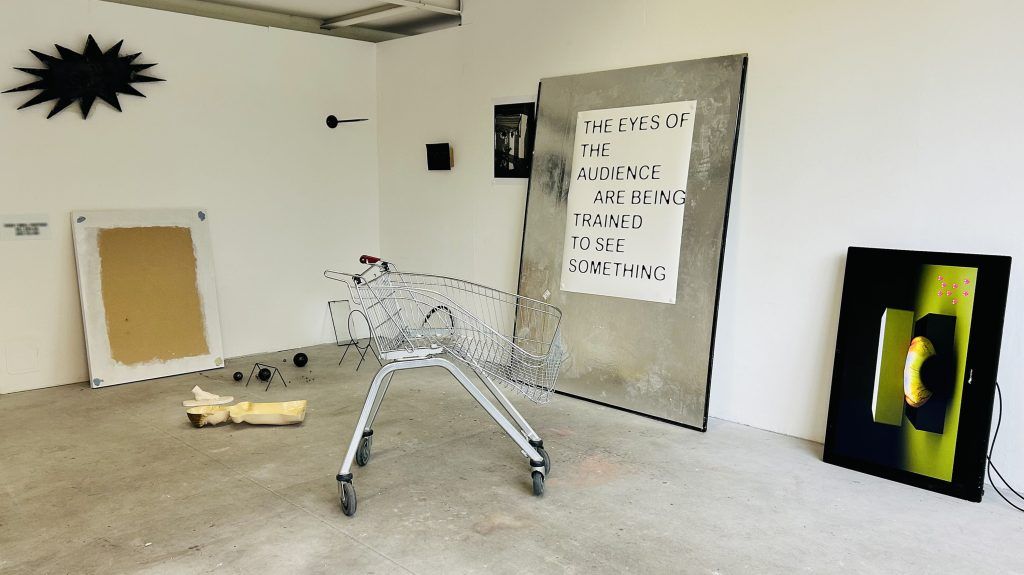
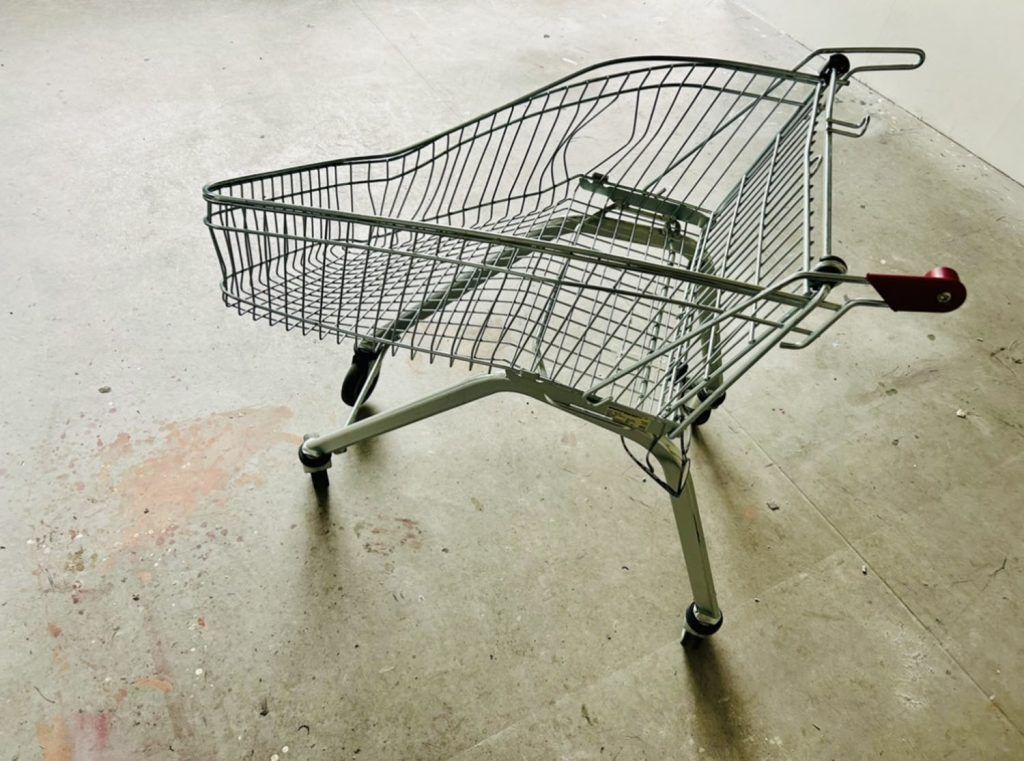
Utopia or Myopia, 2024, Art installation’s fragment (wood, metal, silicone, paint, video)
More about the artwork, written by Nat Coutinho:
Emerging from a deeply personal place, “Utopia or Myopia” originates from countless discussions with my mother, as I tried to convince her of the falsehoods behind the fake news that drove her to panic and delirium. These disputes revealed how easily manipulated images and adulterated journalistic content can fragment the perception of reality, affecting relationships, family tensions, and other social spheres. The relentless search for an image capable of representing such specific affects, embedded in broader political contexts, became the starting point for this work.
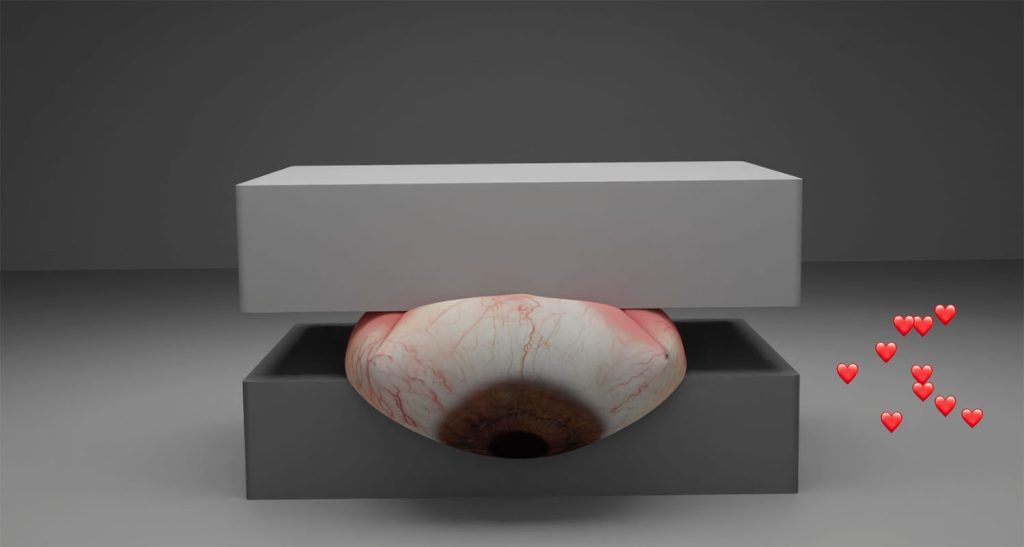
Inspired by Jacques Derrida’s “Memoirs of a Blind Man”, the project invites the public to actively confront perception, disorientation, and the limitations imposed by sight (including a video of an agonizing eye, similar to a meme). The arrangement of objects in the exhibition space, which varies from blurred images to paths leading to blank screens, forms a seemingly random construction, with elements scattered across the floor like obstacles or dog training structures, although these are actually intentionally positioned. This organized disorganization evokes a deliberate sense of spatial uncertainty. However, these elements subtly guide the observer’s movement towards the main focal points of the wall, constructing a trajectory that questions the very process of navigation in search of meaning.